
Last updated: November 2026. Prepared by the tax and corporate team of My Law Associates, led by Mr. Faisal Mehmood, FPA, who has 17 years of experience in audit, sales tax and income tax work.
Picture a wholesale trader in Lahore who sends a buyer a neat PDF invoice, the same way he has for years. The buyer calls back a week later and says, "This has no FBR number on it. My accountant won't accept it." If you hold a sales tax registration, FBR digital invoicing for small business is no longer optional. Your invoices must go through FBR's system and carry an FBR number and QR code.
Short answer: Yes, if you are registered for sales tax. Under SRO 1852(I)/2025, every sales tax registered person had to connect with FBR through PRAL (free) or a paid licensed integrator. Then they had to issue electronic invoices, with phased start dates in late 2025. People with only an NTN, and no sales tax registration, are usually outside this rule. Some service businesses may be added by new notifications.
FBR digital invoicing for small business: is it mandatory?
For sales tax registered businesses, yes. Size isn't the test. Your sales tax registration is. A small sole proprietor with an STRN (sales tax registration number) falls under the same rule as a large company. Only the start dates were different.
What does the rule actually say?
FBR digital invoicing means each sales tax invoice is sent to FBR in real time before it reaches your buyer. It runs through PRAL (Pakistan Revenue Automation Ltd), which is FBR's technology company. Digital Invoicing is a module inside the IRIS portal, FBR's online tax website.
The legal base sits in Chapter XIV of the Sales Tax Rules 2006, which covers licensed integrators and electronic invoices. SRO 1852(I)/2025 then set the dates. According to the Dawn report on SRO 1852 deadlines, companies with turnover above Rs1 billion and individuals or AOPs above Rs100 million had to start issuing e-invoices from November 1, 2025. The other categories followed on dates running up to December 31, 2025.
That phased rollout is now over. In practice, FBR expects every sales tax registered person to be live today.
What is still unclear?
Two things. First, FBR released a draft rule, S.R.O. 288(I)/2026, under the Income Tax Rules. It would require notified businesses such as hotels, marriage halls, schools, couriers and beauty parlours to link their POS or billing software with FBR. It was issued as a draft for public comment, so check its current status before you act on it.
Second, you may read about a "July 2026 deadline" on some websites. We couldn't trace that date to an FBR notification. We'd treat it with caution and go by the latest FBR notification only.
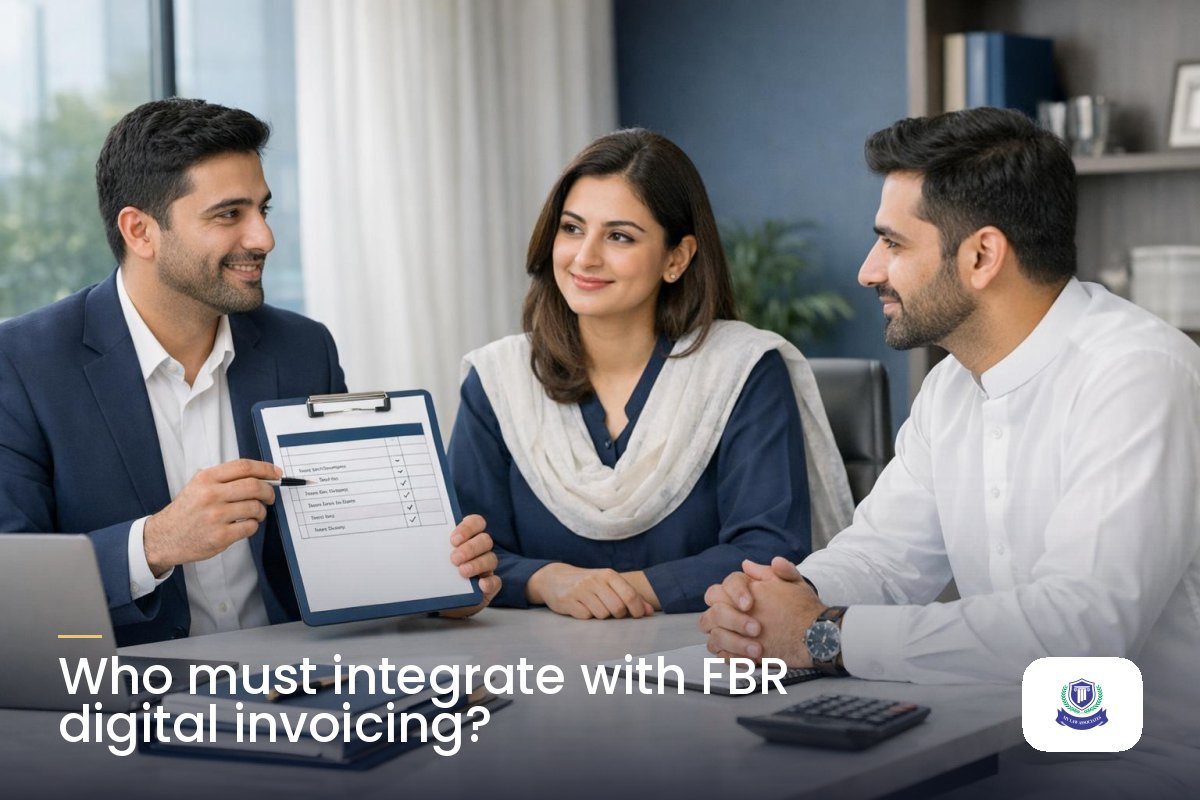
Who must integrate with FBR digital invoicing?
Anyone registered for sales tax must integrate. Tier-1 retailers have their own POS rule. Some service businesses depend on separate notifications. The table below is the quick check we use when a new client asks us this question.
| Your business type | Do you need FBR digital invoicing? | Notes |
|---|---|---|
| Sole proprietor with STRN (for example, a trader or distributor) | Yes | Covered by SRO 1852(I)/2025 |
| Partnership or AOP with STRN | Yes | AOP means association of persons, which is how FBR treats partnerships |
| Private limited or SMC company with STRN | Yes | Larger companies were in the first phase |
| Tier-1 retailer | Yes, through FBR POS integration | A separate POS rule applies at the shop counter |
| Restaurant, clinic, salon, school, courier | Depends on notification | Draft S.R.O. 288(I)/2026 and provincial systems may apply |
| Freelancer or IT company with no STRN | Usually no, under the federal sales tax rule | Provincial or Islamabad services tax rules may still apply |
| Salaried person or NTN-only individual | No | You file income tax returns, but you don't issue sales tax invoices |
I only have an NTN. Does this apply to me?
Usually not. An NTN (national tax number) is your income tax number. Digital invoicing is tied to the STRN, your sales tax number. If you plan to register for sales tax later, expect integration to come with it.
What about Tier-1 retailers and FBR POS integration?
Tier-1 retailers must connect their POS (point of sale, the billing machine at the counter) with FBR. The Sales Tax Act 1990, section 2(43A), defines them. One test covers retailers whose withholding tax under section 236H was more than Rs100,000 in the last 12 months. According to Business Recorder on Tier-1 retailer POS integration, FBR directed 1,680 such retailers to integrate their POS by May 31, 2024.
POS integration and digital invoicing work the same way underneath. The real difference is where the invoice gets made. A POS sends a receipt at the counter for each sale. Software-only e-invoicing sends business-to-business invoices from your billing system or ERP. An ERP is business software that runs accounts, stock and billing together.
Where do PRA and SRB fit in?
Provincial systems are separate from FBR's. Punjab's PRA runs eIMS for services in Punjab. Sindh's SRB runs its own POS system for services such as restaurants. A restaurant in Johar Town, Lahore, may need the PRA system for services tax, not FBR's system. Some businesses need both, which is why we check each case one by one.
PRAL vs licensed integrator vs your own software: which route fits?
Most small businesses should first ask PRAL for free integration. If you need ready billing software and support, use a paid licensed integrator. Build your own link only if you already run a custom ERP and have in-house developers.
| Feature | PRAL (free route) | Paid licensed integrator | Your own software via API |
|---|---|---|---|
| FBR fee | None | None to FBR | None to FBR |
| Cost level | Free on request | Integrator sets its own fees | Developer time and upkeep |
| Setup effort for you | Medium: you need billing software that can connect | Low: the vendor does most of the work | High: your team builds and tests |
| Ongoing support | Limited, through official channels | Usually included in the service | Your own team |
| Best for | Businesses with some IT help and simple billing | Traders, shops and firms that want a ready system | Larger firms with a custom ERP |
PRAL: pros and cons
PRAL has to provide integration free of cost when you ask for it. That's the biggest plus. The downside is that PRAL connects your system, but it isn't your billing software or your accountant. If your invoicing is messy today, you'll still need to fix it.
Paid licensed integrator: pros and cons
A licensed integrator is a company with an FBR licence to connect billing software to FBR. Many sell a full package with software, setup and support. The cons are the fees and the risk of picking an unlicensed seller. FBR's FAQ says only a licensed integrator with a valid licence can configure software for real-time sending, so the licence check matters.
Your own software: pros and cons
Your developers connect your current system through FBR's Digital Invoicing API. That's the technical link software uses to send invoices. You keep full control. But testing, token handling and updates become your job, and the connection still has to be set up through PRAL or a licensed integrator.
How do I check a licensed integrator on FBR's list?
Open FBR's official list of licensed integrators and search for the vendor's exact company name. PRAL is on that list along with private firms. If a seller isn't listed, don't give them your IRIS login.
Can I use more than one integrator?
Yes. A recent FBR general order allows a registered person to use more than one licensed integrator. This helps, for example, if your shop runs one POS and your head office runs a separate wholesale billing system.
Which should you choose?
- You issue a few invoices a month and have basic software: ask PRAL first.
- You run a shop counter or several branches: pick a POS from a licensed integrator.
- You have no software and no IT staff: a licensed integrator with support is the easier path.
- You run a custom ERP with developers: build the API link and test it well in sandbox.
How do I start FBR digital invoicing? Simple steps
You'll move through five steps: check your registrations, pick a route, test in sandbox, get a production token, and go live. For a business with clean records, the hard part is usually data quality, not the technology.
- Check your NTN, STRN and IRIS access. Make sure your sales tax registration is active and you can log in to IRIS. Lost passwords and old mobile numbers delay more cases than anything else we see.
- Pick a route and a billing or POS system. Use the table above. Confirm that the system can print the FBR invoice number, QR code and logo.
- Register and test in sandbox. Sandbox is a practice area. The invoices you send there don't count for tax. Test normal sales, sales to unregistered buyers, and returns.
- Get the production token and go live. Production is the live system, and every invoice there counts. The token is a digital key that lets your software talk to FBR.
- Print the IRN, QR code and FBR logo on every invoice. Check the first few live invoices yourself before you rely on the system.
If you'd prefer not to handle this alone, our sales tax and FBR compliance services cover registration, sandbox testing and go-live.
What must a valid FBR digital invoice show?
A valid invoice must carry an IRN, a QR code and the FBR Digital Invoicing logo, plus the seller and buyer tax details. A plain PDF without the IRN and QR code isn't treated as a valid sales tax invoice.
What are the IRN and QR code?
The IRN (Invoice Reference Number) is a unique number FBR gives each invoice once it is received. The QR code is a square barcode that lets anyone check the invoice with FBR. PRAL's technical specification sets the QR code version and print size. Your software should follow it exactly, because a small or blurred code may not scan.
Which seller and buyer details are required?
- Seller name, address, NTN and STRN
- Buyer NTN if the buyer is registered, or CNIC (national ID card number) for an unregistered end user
- Invoice date and tax period
- HS code, a standard number that tells FBR what product you sold
- Your own invoice number, called the USIN in POS and software
How does a buyer check an invoice?
The buyer scans the QR code or checks the invoice on FBR's verification service. Many buyers now do this before claiming input tax, which is the sales tax they paid on purchases and deduct from their own tax.
Can I correct an invoice after it's sent?
FBR now allows a short window to correct an issued invoice, as per the latest FBR order. After that window, you correct it with a credit note or a debit note. Confirm the current window with us before you rely on it.
What does digital invoicing cost a small business?
FBR charges no fee. Neither you nor your integrator pays FBR anything. Your real costs come from software, hardware and time.
- Software: PRAL integration is free on request. Licensed integrators set their own fees.
- Hardware: a POS terminal or printer if you sell at a counter.
- Power and internet: a UPS and a backup connection for load shedding.
- Staff time: training, entering correct HS codes and fixing buyer data.
Our honest view: don't assume you must pay. Compare the free PRAL route first, then decide whether paid support is worth it for your business.
What happens if you don't integrate?
You face penalties under Section 33 of the Sales Tax Act, 1990, and FBR can suspend your registration under Section 21. There are reports that FBR has already started suspending registrations of businesses that aren't integrated.
How does it hurt your buyers?
An invoice without an IRN can put your buyer's input tax claim at risk. In practice, this is what hurts small suppliers most. Buyers quietly move to suppliers whose invoices verify.
I'm late. What should I do?
- Start integration now. Don't wait for a notice.
- Keep a record of when you applied and when you tested.
- Check your recent sales tax returns against your invoices.
- If a notice arrives, get professional help before you reply.
A missed deadline is a statutory default. It doesn't automatically mean fraud. We represent clients before field tax authorities, FBR and appellate forums. See our tax notice and legal representation services if a notice has already come in.
What mistakes do businesses make with digital invoicing?
Most problems come from bad data and weak vendor checks, not from FBR's system. These are the mistakes we see most often.
Which invoice errors come up most?
- Sending a plain PDF with no IRN or QR code
- Typing the wrong buyer NTN or CNIC
- Using the wrong HS code for a product
- Missing the correction window, then forgetting to issue a credit note
- Having no internet backup, so counter sales pile up unsent
How should you check a vendor?
Check the exact company name on FBR's licensed list. Ask who will help you when the token expires or a sale fails to post. If a seller pushes you to sign up before you can see a sandbox test, slow down.
How do you keep your token and login safe?
Your API token and IRIS login are credentials, just like a bank password. Don't send them on WhatsApp. Give token access only to staff who need it. Ask your vendor how it stores buyer CNIC and NTN data. We follow a privacy-first approach with client credentials for this reason.
Why check Annexure-C every month?
Annexure-C is the part of your sales tax return that lists your sales. Annex-A lists your purchases. Before you file each month, match Annexure-C against the invoices posted to FBR. Small gaps found early are easy to fix, but gaps found in an audit are not.
How can My Law Associates help with digital invoicing?
We handle the full path: sales tax registration, picking the right route, testing and going live. We also run our own FBR-integrated, S.R.O 350 digital invoice and POS system, and you can ask for a free demo.
Since 2010, our Lahore team of more than 25 professionals has worked with over 130 client organizations. That includes 36 in energy (LPG, oil and gas), 26 in technology and IT, 26 in trading and services, 18 in manufacturing and 16 in engineering and construction. A Gulberg clinic, a wholesale trader and a Lahore IT firm don't face the same rules, and we match the service to your business type.
- Sales tax registration, monthly returns and digital invoicing setup
- NTN registration and income tax return filing if you also need filer status
- Notice replies and representation before FBR and appellate forums
Notified categories change often. A quick call with our team can confirm which category you fall in before you spend money on software.
Frequently Asked Questions
I am a sole proprietor with sales tax registration. Do I need digital invoicing?
Yes. SRO 1852(I)/2025 covers all sales tax registered persons, including sole proprietors. Your start date has passed, so you should already be issuing invoices through FBR's system.
Is FBR digital invoicing free?
FBR charges no fee. PRAL provides integration free on request. Licensed integrators charge their own fees, and you may still spend on hardware and software.
Do I need a licensed integrator for FBR digital invoicing?
You need either PRAL or a licensed integrator to connect your system. PRAL is itself on FBR's licensed list, so you don't have to pay a private vendor.
What is an IRN on an FBR invoice?
It's the unique Invoice Reference Number FBR gives each invoice once it's received. Without it, the invoice isn't valid for sales tax.
What does the FBR QR code contain and how big must it be?
The QR code links the invoice to FBR's records, so anyone can scan it and check it. PRAL's technical specification sets its version and print size, and your software should follow that specification.
How do I integrate my POS with FBR?
Choose a POS from PRAL or a licensed integrator, then register in the IRIS Digital Invoicing module. Test in sandbox, get your production token and go live. Make sure every receipt prints the IRN, QR code and FBR logo.
Can I correct an invoice after sending it to FBR?
Yes, within the short correction window FBR allows, as per the latest order. After that window, use a credit note or debit note.
Ready to get your invoicing FBR-compliant?
If you hold an STRN, digital invoicing is part of your sales tax work now. The good news is that FBR charges nothing, and the steps are clear once your data is clean. Pick the right route, test properly, and check your returns every month.
Need help with this? Book a free consultation with My Law Associates. Call or WhatsApp 0334-4007652, call 042-35786746, email faisalfpa@gmail.com, or visit our office at Office 612, 6th Floor, Eden Heights, Jail Road, Lahore. Our team will review your case and handle the complete process for you. You can also ask for a free quote or a call back.
This article is for general information. Every case is different; please consult our team before acting.